Showing posts with label Islamabad. Show all posts

Friday, April 24, 2015

Travel and Safety in Pakistan

How to Visit Pakistan and Enjoy the Ride. (courtesy John Diaz)
Whenever I tell my fellow Americans I have been to Pakistan -- twice -- their reaction indicates that I must be crazy or clueless. Yes, it can be a dangerous place. Heed the warnings from the US State Department. But it's possible to visit Pakistan and enjoy the experience.

Friends in Secure Places
This is not a country where a Western visitor can stroll around and explore at will. On my first visit in 2012, I was with a group of American journalists escorted by the East-West Center and a Pakistani partner organization, PILDAT. In 2014, I was on a teaching grant from the US State Department, which took precautions for my safety whenever I was scheduled to leave the hotel. In order to get out of the security cocoon and see something, you need local friends who know the territory and are willing to spend time showing you around while looking out for your safety. Having friends on the inside will allow you to discover places like the Karachi Boat Club, a riverside escape from the craziness of the city, but for members only.
A warm welcome in Karachi at 3 am. Thanks Mushtaq!
Welcome to Karachi
If you are fortunate enough to experience Pakistani hospitality, it can be overwhelming. On my most recent arrival in Karachi, my Sindhi journalist colleague Mushtaq Sarki met me at the airport. With flowers. At 3.a.m. "This is our tradition," he explained. When we later realized my son had left his I-Pad on the Turkish Airlines plane, Mushtaq worked his contacts at the airport and the hotel dispatched a car to retrieve it. What are the chances of that happening in any other country? Another aspect of the hospitality tradition is showering the guest with gifts, so pack a generous number of gift items from your home country to reciprocate.
Awesome women journalists in Karachi.
(courtesy US Consulate)
Instant City
Before visiting Karachi, I highly recommend reading "Instant City," a book by NPR reporter Steve Inskeep that explains why the place is such a fascinating, hot mess. Even if all you see is the streetscape from a fast moving van, armored car or taxi it's a cultural overload of donkey carts and brightly painted buses and trucks. My first trip to Karachi included one day when the streets were eerily empty. The city was on lockdown due to the latest violent outbreak of a political feud. Our group ventured out anyway and our van was quickly followed by some menacing dudes on motorcycles, the kind who have a reputation for being possible assassins. Even on a "normal" day, traffic is always unpredictable as police shut down random streets for constantly shifting security reasons. Like people in my hometown of Los Angeles, folks here understand when you are late to an event because of traffic. Perhaps for this reason, people have a tendency not to plan ahead and do things on spur of the moment. Any invitation is likely to be followed by a hopeful "insha Allah," which means "God willing." Because of "load shedding" Karachi residents must endure hours of blackouts every day, and demonstrators frequently hit the streets to demand electricity, causing closures and traffic jams. My hotel had a generator that kicked in a couple of times a day.
With an adventurous American friend, I was fortunate to find a friendly hotel-approved cab driver who helped us escape the security cocoon long enough to have an elegant dinner at Okra and a night camel ride on the beach. He also alerted us when it was time to cut the camel ride short because "people are talking bad about you." Don't question these warnings and stay safe.
Shopping buddies helped me navigate the (now-closed) Sunday market in Defense.
Standing Out and Fitting In
Not all women in Pakistan cover their hair and, unless I've been invited to a mosque or other religious place, I don't either. But I carry a scarf just in case. My blonde locks are a sure attention-getter, and it's not always harmless curiosity. If your Pakistani host tells you it's time to move out of an area, don't question it. Many of your outings will be to places like the Port Grand mall, which requires passing through TSA-like security to enter the array of upscale shops and restaurants. In 2012 I was able to shop for bargains in the stalls of the Sunday market in the upper class neighborhood of Defense, with translation and price-haggling assistance from a helpful journalism student. But marketplaces are frequent targets and this type of shopping was discouraged in 2014. I've been told the Defense market is no longer operating. In any case, you'll want to visit a shop like Koel and buy a few shalwar kameez, the kaftan-like dresses (and shirts for the men) worn everywhere in Pakistan. You'll get lots of compliments from Pakistanis who appreciate your willingness to embrace their culture.
Shopping for Shalwar Kameez in Karachi.
Lahore
This garden city takes pride in being a center of higher education. It's greener and less dusty than Karachi, but security is still a concern. For a fun night out, friends led the way to the Food Street, a relic of times before the 1947 partition of Pakistan and India. The crumbling colonial-era buildings have been turned into food stalls serving local specialties, including every part of the animal. Pakistanis love meat and being a vegetarian here can be a challenge. Again, it helps to have friends looking out for you. My host made sure we were served the freshest food and not something that had been sitting around for a while.
You'll need friends to help you place an order on the Food Street in Lahore.
(courtesy Linda Roth)
My visit coincided with a planned political demonstration near the hotel where I was planning to stay, so I was moved to an extraordinary Heritage Hotel called The Moor. This place is so secure that you must be pre-cleared in order to stay here. The room service, delivered by a friendly butler, was fine for breakfast and a light dinner, and I was able to walk to a nearby restaurant with a colleague.
Lahore has a number of historic attractions that I couldn't fit in on this business trip and coming back to see the India border ceremony is definitely on my list for the future. (Update: the border crossing has also been a terrorist target. Use caution when visiting.)
Be careful at ATMS. A bank machine swallowed my friend's card and the local branch of the issuing bank was no help. To get a replacement she had to contact customer service in the US on Twitter. Even though the exchange rate wasn't very good, I opted for changing money at the airport or hotel.
At the Great Faisal Mosque in Islamabad.

Islamabad
When staying at the Marriott, be aware that his hotel was the target of a suicide truck bomb in 2008, killing at least 54 people, injuring several hundred and leaving a large crater in the hotel. Security is a concern every time you enter or leave. On my first visit, I was welcomed to the home of a Pakistani journalist and his charming family. They managed to get the kids'  homework done and put dinner on the table just in time for the nightly "load shedding" blackout, and we ate by candlelight. The city is laid out in blocks with large undeveloped spaces and doesn't invite the visitor to take a stroll anywhere. Again, you'll rely on your local contacts to show you such highlights as the Great Faisal mosque, which is off limits to non-believers. All government buildings, and even NGOs, have dudes with automatic weapons to guard their gated compounds. Friends will guide you to places like Khaadi for upscale clothing, or outlets for more basic handicrafts with negotiable prices. Saidpur Village, while touristy, gives a glimpse of life outside the urban zones, where kids will eagerly jump in front of your camera and a nearby goat market shows off tonight's dinner still on the hoof. To escape the city, plan a trip up the Margalla Hills to the Monal restaurant.
Welcome to the goat market at Saidpur Village.
Peshawar
Some of the nicest and most welcoming Pakistanis I met in 2014 were journalists who had traveled from Peshawar to participate in our training in Islamabad. Peshawar is the capital of the Khyber Pakhtunkhwa, the tribal area in the northwest of Pakistan.  As of this writing, it is far too dangerous for an American traveler to take advantage of their warm invitation to visit their beautiful and often violent city in the foothills of the Himalayas. But someday...  insha Allah.
Meeting journalists from Peshawar in Islamabad. (courtesy Linda Roth)


Tuesday, May 15, 2012

Cone of death?

A lot of people have asked me if I was in any danger in Pakistan. Turns out one of the riskiest things I did was... eating an ice cream cone!
It was a hot and dusty day in Islamabad as I walked through Saidpur Village, and the soft-serve ice cream was hard to resist. But when I caught up with the rest of the group, our leader Ann Hartman screamed in horror. As a former peace corps volunteer in the region, Ann knew that soft-serve ice cream from a street vendor can be poison if it's made with unpasteurized milk or polluted water.
I went back to the hotel and waited for the cone of death to strike me down, but fortunately I had no symptoms of gastric distress. Whew!

Wanna buy a goat?

A short walk from Saidpur Village was a goat market. Except for a few moms escorting their kids through the market on their way home from school, I was the only woman there. But I was treated with both courtesy and curiosity by the goat sellers.

 One spoke a few words of English and insisted I take this picture of him with one of his nicest goats. The going price is the equivalent of around $70, I was told, but maybe that's what they charge the tourists. However, I had to decline. This is one souvenir that would never get past the USDA.


Saidpur Village


My Lonely Planet tour book describes Saidpur Village in Islamabad as "model village" set to open in 2008 to "showcase Pakistani cultural handicrafts and traditions." 

Visiting on a Friday afternoon in 2012, the reality was hardly a showcase. There were several upscale restaurants, but most of the shops seemed to be struggling or abandoned, and the only pottery for sale was at a small roadside stand. 

But it was a welcome break from government policy briefings because of the actual village adjoining the tourist attraction. 

Children eagerly jumped in front of our cameras as we picked our way along the stream that runs through the settlement. Their faces are unforgettable.

Threats to Journalists


 Visiting the Ministry of Information in Islamabad was like a trip in a time machine. It's a throwback to when "journalists" in Pakistan worked only for state-controlled media, dutifully distributing government press releases. The minister, Dr. Firdous Ashiq Awan, sat at the head of a long conference table. We were seated among the members of her sizable staff. The lights dimmed and we were shown a 14 minute video called "Vibrant Pakistan." A narrator with a soothing American accent assured us of Pakistan's stable business and political climate, and even the war-torn tribal regions were presented as enticing tourist destinations.
 Watch the video here.
 
The minister was more politician than spokeswoman. She is also a sitting member of Parliament from the ruling PPP, the center-left party of former prime minister Benazir Bhutto's family. Dr. Awad spoke of the "gap of perception and reality" between Pakistan and the US, saying international partners "have not helped us the way we were expecting." She criticized US drone attacks on terrorist targets as a violation of Pakistani sovereignty and said "our friends have not given us the political space to explain why we have to be with them as a power," quickly adding, "no one wants to disassociate from the USA."

The gap between perception and reality was most obvious when the discussion turned to the threats facing journalists and what the government might do to improve their security. The minister said the threats were "fabricated" and directed against "oversmart guys who put their own interest ahead of the national interest."
When a Pakistani stringer for a US news organization respectfully challenged her statement by telling how he had once been seized and warned not to include certain facts in his reporting, the minister did not budge. She went on to criticize sensationalism in privately-owned media that has developed in the past decade. "Free media is a new concept for us," she said. "You can have a proper security cover (for journalists), but they need proper training." On that note, it was time to adjourn for refreshments and photo opportunities.

UPDATE: We met other Pakistani journalists who told us of the dangers they face. One of them was found strangled to death less than a month later. Read the article by John Diaz in the San Francisco Chronicle here.

After I returned to the US and had time to do a little more research, I learned that Dr Awan had turned in her resignation in December 2011, when she was criticized for her response to "memogate." The scandal involved a memo in which representatives of Pakistan's civilian government allegedly asked for US help in curbing the power of Pakistan's military. Shortly after our visit, she was reassigned to the Ministry of National Regulations and Services. Her replacement is another PPP politician, Qamar Zaman Kaira. His bio says he is known as "one who raised his voice for freedom of speech and democracy during the military government in the country." Only time will tell if he will confront the forces of darkness and make Pakistan a safer place for journalists. A good place to start would be demanding more effective law enforcement to catch, convict and punish those who harm journalists. For another dose of reality, read this excellent Q and A with assistant editor Sajid Hussain of the News International in Karachi, one of the Pakistani journalists on our exchange.Read the article in Global Journalist here.

It's hard to see the role of the "Ministry of Information" in modern public relations. It's not just Pakistani journalists who need training; government spokespersons need to learn their role in responding to press inquiries and communicating with the public. Freedom of information and transparency should be encouraged in all public agencies, rather than having one "Big Brother" that gives out only self-serving propaganda and runs state-owned broadcasting media in its own interest.

Faisal Mosque


The Shah Faisal Mosque is one of the largest mosques in Asia, with its four minarets towering over Islamabad at the foot of the Margalla Hills. According to Lonely Planet, there's an urban legend that the CIA once suspected the towers of being missiles in disguise.


Funded mostly by the Saudis, and designed by a Turkish architect, the building cost $45 million and took more than 10 years to complete. The design is a departure from the usual dome with sloping geometric lines inspired by desert tents.
Visitors must observe the usual protocol and remove shoes. Women must cover their heads. The main prayer hall can accommodate 8,500 men and 1,500 women. Our group was swallowed up in the vast space as we posed for pictures.


We visited Islamabad shortly before Easter, and in this Muslim country it was surprising to see a display of Easter bunnies in the hotel lobby. Perhaps it was an effort to make international guests feel a little more at home, or just a celebration of spring.

Monday, April 9, 2012

Family Night in Islamabad


Host families are one of the best features of the Pakistan-US journalists' exchange. Each visiting American was assigned to visit the home of a journalist working in Islamabad. I was paired with Dawn TV anchor Matiullah Jan, who also covers the courts at a time when Pakistan's judiciary is taking a more active role. He is best known for his program called "Apna Gareban" or "Under Our Collar" which exposed unethical behavior in the media.

Saturday, March 31, 2012

Good Morning Islamabad!

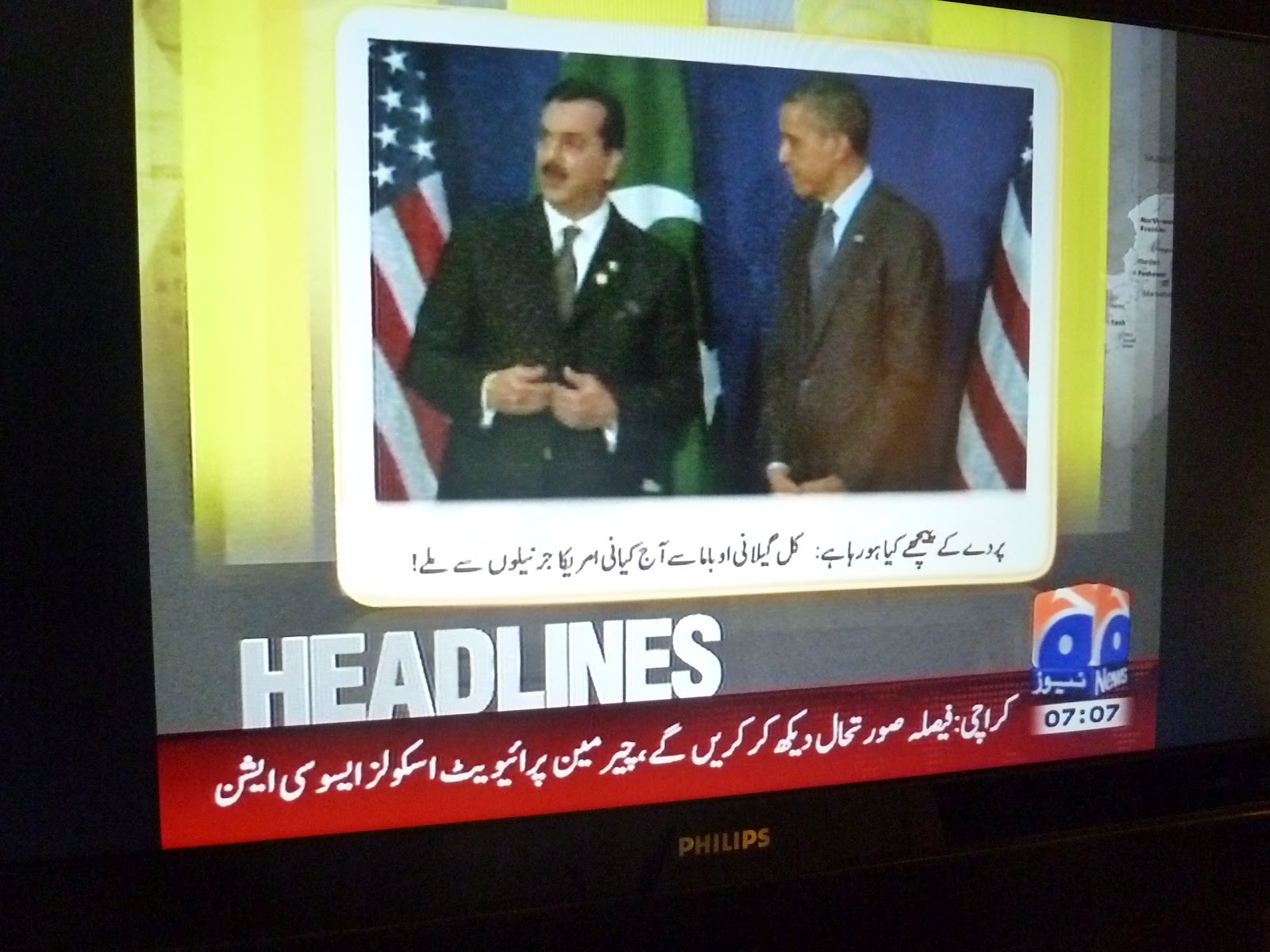
Six American journalists have arrived in Islamabad as the Parliament here is debating the future of US-Pakistan relations. It's one of the top stories on the morning TV news. Pakistan's president has met with President Obama in South Korea, and top military officials from both countries are meeting for the first time since a US airstrike killed 24 Pakistani troops along the border with Afghanistan in November.

As we began a series of meetings in the capital, nearly everyone told us that US-Pakistan relations are at a low point. Pakistanis feel they have paid a high price for the war on terror, while Americans may question how much they can trust Pakistan as a post-9/11 ally. For a reminder of the tension, we needed to look no further than the entrance to our hotel, the Marriott which was bombed in 2008. Today the hotel's website boasts of its bomb-proof glass. Security officers checked under the hood of our van and scanned our belongings every time we came in. But it's not just a hassle for the foreigners staying at the Marriott; there were checkpoints all over the city. Pakistanis also have to endure several power blackouts a day due to fuel shortages,  and the country's economy is reeling from the war on terror, which has scared businesses away.

Our first stop was PILDAT, the Pakistan Institute of Legislative Development and Transparency. This organization is the sponsoring partner of our journalism exchange, along with the East-West Center in Hawaii. PILDAT's director, Ahmed Bilal Mehboob, was surprisingly upbeat. Pakistan, he said is "enjoying its finest period of democracy" since its founding in 1947. He singled out the activist judiciary and the feisty, independent media, particularly the privately owned broadcast channels, as bright spots. Looking ahead to 2013, he said, "The next election is critical. If it takes place and it's a fair election we will have made a great leap forward."

Of course, there are plenty of pressures that could push Pakistan in the other direction. In the middle of the meeting at 11:05 a.m., the power went out. Mr. Mehboob didn't skip a beat as he outlined the issues that are dividing the two countries. Pakistan wants an apology for the deaths of the troops killed on the border and an end to anti-terrorist drone strikes that also kill civilians. The US wants to resume supply convoys that travel through Pakistan to reach NATO troops in Afghanistan. Pakistan wants an energy pipeline from Iran, while the US is trying to isolate Iran to discourage its nuclear program. Pakistan already has nuclear weapons pointed at its nuclear-armed neighbor, India, in a standoff of mutually assured destruction. India also has a program to develop civilian nuclear power, but because of concerns about security, the US has not endorsed a similar effort for energy-starved Pakistan. Pakistan spends billions in aid money from the US, while resenting the strings that are attached to American taxpayers' money. US policymakers would like to feel a little more love after being the world's biggest donor to Pakistani earthquake and flood relief.

Later in the day we zipped passed the Parliament building and saw members of an Islamist party demonstrating against the US. But in addition to a long list of divisive issues, we also received an overdose of Pakistan's legendary hospitality. Beginning with PILDAT, we were served coffee, tea and snacks at nearly every meeting we attended. We also experienced a mountaintop restaurant with a group of forward-thinking Pakistanis and American ex-pats. We were surrounded by festive groups of locals enjoying lavish grills of meat, the essential ingredient in the Pakistani diet. Looking out at the view of the lights below, we could have been in the Hollywood Hills looking over the LA basin. Except that it was Pakistan, a land of contrast and contradiction that we have only begun to explore.